Back
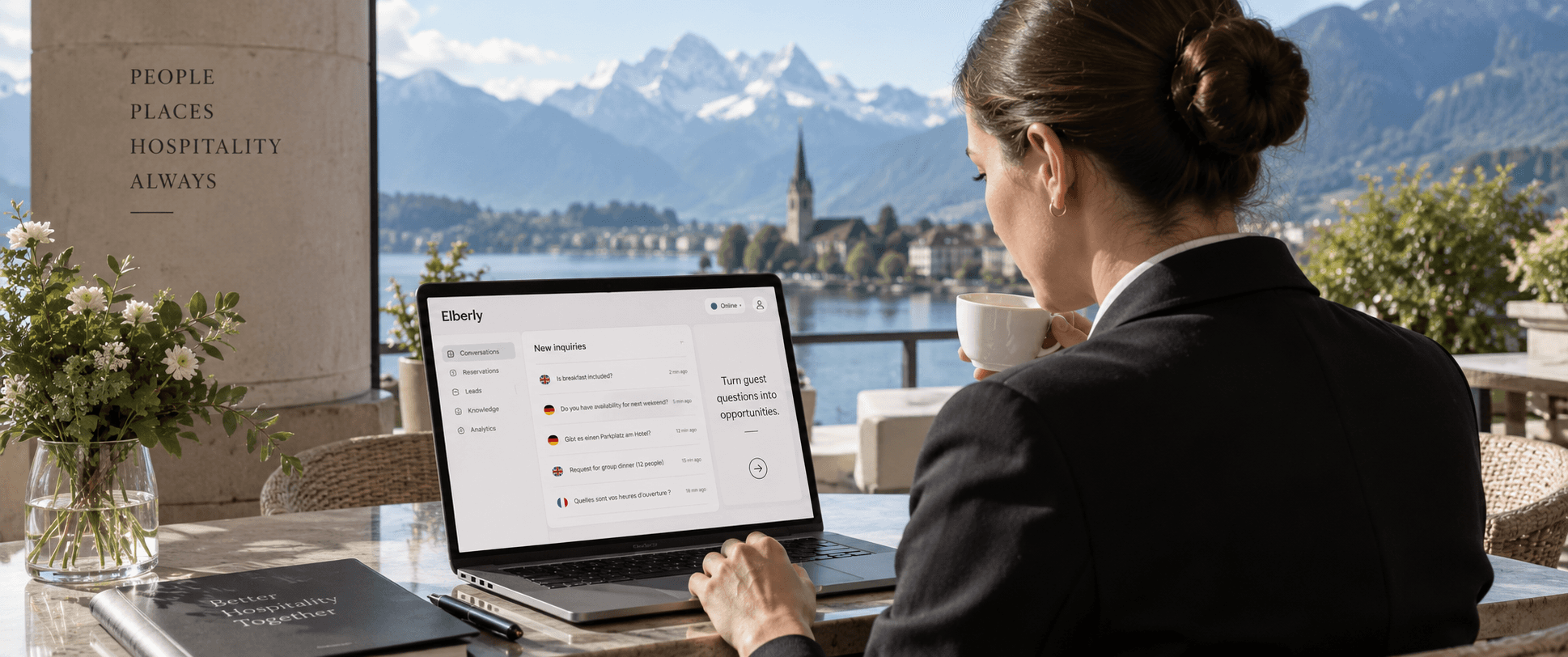
Swiss standard, modern pressure: precision service with lean teams.
Swiss hospitality has a reputation built over generations: precision, discretion and a standard of service that guests notice within minutes of arrival.
It also faces a distinctly modern set of pressures.
Staff shortages across hotels and gastronomy, guests who expect immediate answers on every channel, and operations that must deliver premium service with lean teams.
This is the context in which AI has become a serious topic for Swiss hoteliers and restaurant operators, not as a trend, but as an operational question.
Why AI in hospitality is an availability question, not a technology question
Most hotels and restaurants do not lose opportunities because demand is missing.
They lose them because communication capacity is limited.
Calls arrive during check-in.
Booking questions arrive after closing.
Website visitors leave without finding the answer.
The demand was there; the availability was not.
AI tools for hospitality address precisely this layer: answering, capturing and routing requests when the team cannot, so that human attention goes where it matters most.
The Swiss expectation paradox
Swiss hospitality operates inside a paradox.
Guests choose Swiss properties partly for the human quality of service, and they simultaneously expect the responsiveness of a digital-first world: an answer tonight, not tomorrow morning.
Meeting both expectations with staffing alone means overstaffing quiet hours, which no operation can afford, or accepting gaps, which costs bookings.
The realistic third option is a division of labor: humans deliver the service moments that define the property, and systems guarantee that no request falls into the gaps between them.
Handled this way, AI does not dilute the Swiss standard.
It protects it during the hours the standard was previously unguarded.
The multilingual reality
Switzerland adds a communication requirement most markets do not have: operating naturally across German, French, Italian and English, often within a single day, plus the languages of international guests.
Staffing every shift with every language is impossible for most properties.
This is one of the places AI assistance is most immediately valuable, because a well-built assistant answers each guest in the guest's own language regardless of who is on shift, and does so consistently.
For properties in multilingual regions or with strong international demand, this alone changes the daily experience of the front desk.
What responsible AI adoption looks like for Swiss operators
Swiss buyers are rightly skeptical of hype, and hospitality is a trust business.
Responsible AI adoption in this market follows a few principles.
Start with a real operational pain, such as missed calls or repetitive inquiries, rather than adopting AI for its own sake.
Insist on systems grounded in approved knowledge sources, with clear escalation to humans.
Roll out in phases with defined testing, instead of switching on a black box.
And keep the human side of service untouched: AI takes the repetitive layer, the team keeps the guest.
Data handling deserves the same care.
Operators should understand where guest data flows, which systems the AI connects to, and how updates and corrections are managed.
Any serious provider will review this openly during specification rather than waving it away, and will be comfortable putting the answers in writing.
Where Swiss hotels and restaurants are starting
The most common starting points in the Swiss market are practical.
A website-based virtual assistant that answers guest questions and routes inquiries.
An AI receptionist that captures calls and booking requests during peaks and off-hours.
An internal assistant that gives team members instant access to the operation's own knowledge, so new staff find answers without interrupting senior colleagues.
Each addresses a visible, measurable pain point, which is why they succeed where broad digital transformation projects often stall.
Build, buy or partner
Operators evaluating AI face three paths.
Building in-house is realistic only for large groups with technical teams, and even then rarely worth the maintenance burden.
Buying a generic off-the-shelf chatbot is cheap but tends to fail on grounding, boundaries and hospitality fit, which is why so many operators report a failed first attempt with tools their teams never adopted.
The third path is partnering with a specialist that builds tailored systems around the operation's actual workflows and stays involved after go-live.
For most Swiss hotels and restaurants, the third path is the one that produces a system the team actually uses, because adoption, not technology, is where these projects succeed or fail.
The Elberly perspective
Elberly is an AI company based in Zug, Switzerland, focused entirely on hospitality, gastronomy and service operations.
It builds three systems, the Virtual Assistant, the AI Receptionist and the Internal Assistant, as one operational layer covering the website, the phone and internal knowledge.
Every project runs through a structured process: conversation, specification, build and integration, team training, and live operation with ongoing support.
Swiss-based, hospitality-specific and delivered on evidence rather than promises.
Frequently asked questions
Is AI worth it for a small independent hotel?
It can be, when a clear pain exists such as missed calls or repetitive questions.
The key is starting with a focused use case and a defined scope rather than a large transformation project.
How do Swiss data expectations affect AI in hospitality?
Swiss operators should expect transparency about data flows, system connections and knowledge sources.
A proper specification phase reviews these questions before anything goes live.
What is the first step for a hotel or restaurant considering AI?
Map where requests are currently lost or delayed: phone, website, email, forms.
The channel with the biggest leak usually defines the right starting point.
Can AI really work in a multilingual environment like Switzerland?
Yes, and multilingual coverage is one of the strongest arguments for it.
Guests are answered in their own language on every shift, which staffing alone can rarely guarantee.
Why do so many first attempts with chatbots fail?
Usually because the tool was generic: no grounding in the operation's own knowledge, no escalation rules and no fit with real workflows.
Teams stop trusting it and work around it.
Tailored, phased implementations avoid this pattern.
Elberly AG, Zug, Switzerland.
Operational AI for hospitality and gastronomy: Virtual Assistant, AI Receptionist, Internal Assistant.
elberly.com